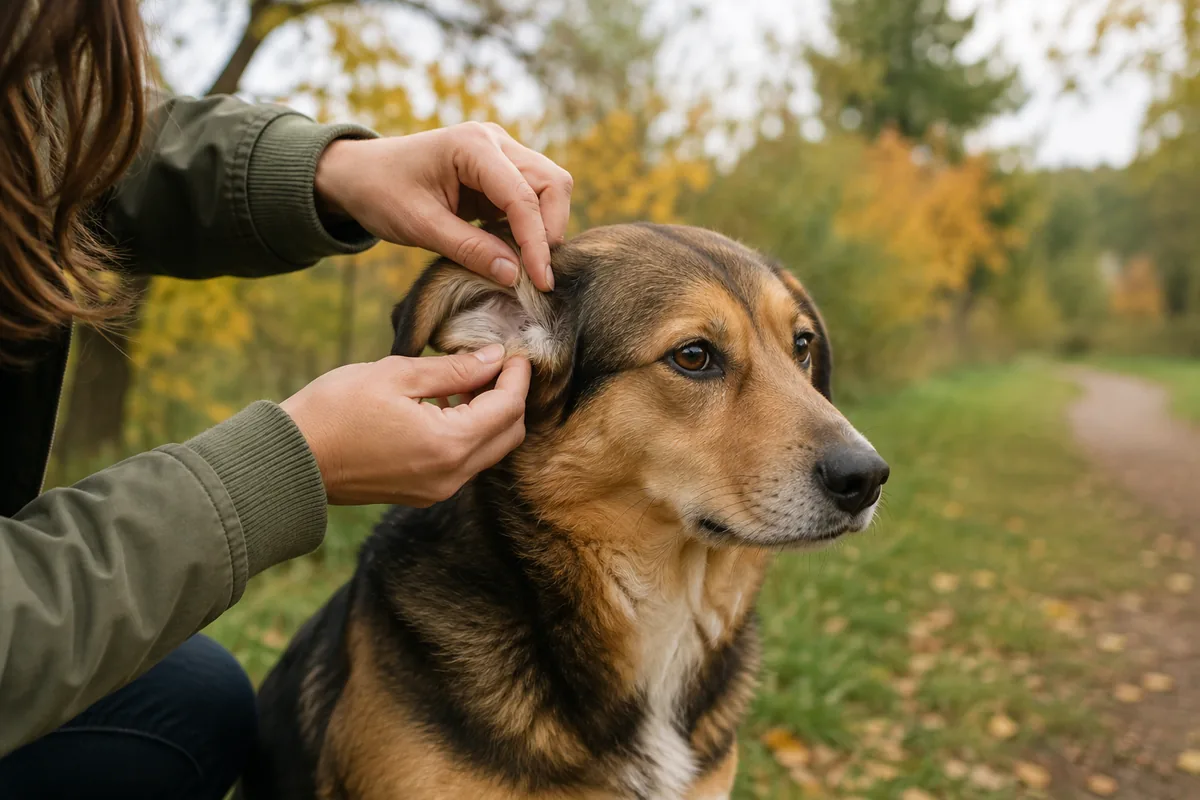
Remove an attached tick promptly with fine-tipped tweezers, photograph and save it, clean the bite site, and submit the photo through Alberta’s eTick process. Call a veterinarian if you cannot remove it safely or your dog seems unwell. Ticks do not necessarily disappear when summer ends: Alberta Health says they can be active above 4°C.
Why fall still counts as tick season in Edmonton
A cool morning does not mean tick activity has ended. Alberta Health says ticks are most active in spring, summer and fall and can be active above 4°C. The Public Health Agency of Canada says activity is possible when temperatures remain above freezing and the ground is not covered by snow.
Season varies by species. The Canadian Veterinary Medical Association reports that adult blacklegged ticks are typically most active in fall. Ticks can also find warmer microenvironments under leaves or in sheltered vegetation, so the calendar is not a perfect cutoff.
Ticks are associated with grass, shrubs, wooded edges and leaf piles. Exposure can happen on a neighbourhood walk, in a natural area or backyard, or while travelling. Note where your dog has been, because a tick found in Edmonton may have been acquired elsewhere.
Where should I check my dog for ticks?
After time around tall grass, brush, woodland or leaf litter, run your hands slowly over your dog. A small tick may feel like a seed or tiny bump before it is easy to see. Good light and a comb can help with thick coats.
- The head, muzzle, chin and outer ear flaps
- The neck and underneath the collar or harness
- The shoulders, armpits and front legs
- The belly, groin and around the tail
- Between the toes and around the paw pads
Part the coat when you feel a bump. Lumps, scabs and nipples can be mistaken for ticks, so take a clear photo and call your veterinary team before pulling if you are unsure.
Check yourself and other pets too. A dog does not give Lyme disease directly to a person, but an unattached tick carried indoors could attach to another animal or human.
How to remove a tick from your dog safely
1. Gather your supplies
Use fine-tipped tweezers, disposable gloves, a clean plastic container with a tight lid, your phone, and soap and water. Ask someone to help keep your dog calm if that can be done safely.
2. Grasp close to the skin
Part the fur and place the tweezers around the tick’s head or mouth area, as close to your dog’s skin as possible. Avoid squeezing the swollen body.
3. Pull upward steadily
Pull straight up with slow, even pressure. Do not twist, jerk or crush the tick. Use a purpose-made removal tool only according to its directions.
4. Clean and save
Clean the bite site and wash your hands. Photograph the tick, then place it in the sealed container.
If your dog will not hold still, the tick is near an eyelid or another sensitive area, there are several ticks, or you are uncomfortable removing it, call Lakeview during clinic hours for guidance.
What should I do with the tick in Alberta?
Alberta’s Submit-a-Tick process begins with a photo submitted through eTick or its app. It helps identify tick species and supports surveillance.
Alberta Health advises keeping the tick in a clean, empty plastic container with a tight lid for at least 10 days after submitting the photo. Do not add ventilation holes. The container may be refrigerated or frozen. Submit the specimen to Alberta Precision Laboratories only if eTick requests it.
eTick does not diagnose your dog or test pets for tick-borne illness. Do not wait for an identification result if your dog is unwell.
When should I call a veterinarian?
Call for guidance
You cannot identify or safely remove what is attached, several ticks are present, or the bite becomes increasingly red, swollen, painful or starts draining.
Call the same day
Your dog develops fever, unusual tiredness, reduced appetite, swollen joints or lymph nodes, or a limp that shifts between legs.
Emergency care now
Your dog collapses, has trouble breathing, has a seizure, cannot stand, has pale or blue-grey gums, or worsens rapidly.
These signs are not specific to Lyme disease. Tell the team when you found the tick, where your dog has been, whether it was attached, and what prevention was used.
Lakeview provides urgent and same-day care during clinic hours when availability permits; it is not a 24-hour hospital. For a life-threatening problem after hours, contact a 24-hour veterinary emergency hospital. See Lakeview’s urgent and same-day care information and pet-emergency guide.
Does every dog need a test or antibiotics after a tick?
No. A veterinarian may consider where the tick was acquired, travel, likely attachment duration, species, symptoms, medical history, prevention and vaccination. Timing also affects what a blood test can show. Tick identification alone does not establish infection.
Do not give leftover antibiotics, human medication or another pet’s parasite product. Your veterinarian will recommend monitoring, testing or treatment only when appropriate for your dog.
How can I reduce fall tick risk?
The Canadian Veterinary Medical Association describes a layered approach: regular checks and prompt removal, tick-control medication during the relevant risk period, and Lyme vaccination for dogs when indicated.
- Check your dog after walks near brush, grass, wooded edges and leaves.
- Trim tall grass and clear leaf or brush piles around frequently used areas.
- Ask when prevention should start and stop rather than relying only on the calendar.
- Discuss hiking, camping, dog parks and travel when choosing prevention.
- Keep checking even when your dog uses a preventive product.
Lakeview offers individualized parasite-prevention guidance based on species, age, weight, health and exposure. Never use a dog parasite product on a cat; some canine products can seriously harm cats.
Frequently asked questions
Are there ticks in Edmonton?
Yes. Ticks can be encountered in Alberta, including around Edmonton, and the province monitors submissions from people, pets and the environment. The eTick map records submissions; it is not a guarantee that a location is safe or unsafe.
Are ticks active in September and October?
They can be. Alberta Health lists fall as an active season, and the CVMA notes that adult blacklegged ticks commonly peak in fall. Activity depends on species, temperature, snow cover and local conditions.
Does every tick bite cause Lyme disease?
No. Most tick species in Alberta do not carry the bacterium that causes Lyme disease, and attachment does not automatically mean infection. Prompt removal still matters because risk varies by species and location.
What if mouthparts remain in my dog’s skin?
Do not dig deeply. If a small piece cannot be lifted easily with clean tweezers, clean the area and call your veterinarian. Watch for increasing redness, swelling, pain or discharge.
Does my dog need a Lyme vaccine?
It depends on exposure and individual risk. A veterinarian can consider outdoor activity, travel, health and prevention history. Vaccination, when indicated, complements tick control and checks; it does not replace them.
Can cats get ticks?
Yes. Outdoor cats and travelling cats can encounter ticks, and ticks may be carried indoors. Prevention must be selected specifically for cats. Never apply a canine product unless a veterinarian has confirmed it is safe.
Veterinary and public-health references: Alberta Health, Public Health Agency of Canada, Canadian Veterinary Medical Association, Alberta Veterinary Medical Association, and Merck Veterinary Manual.
Medical note: This article provides general education and does not replace an examination, diagnosis or individualized veterinary advice. Reading it does not establish a veterinarian-client-patient relationship. If your pet is ill, injured or worsening, contact a veterinary professional promptly.