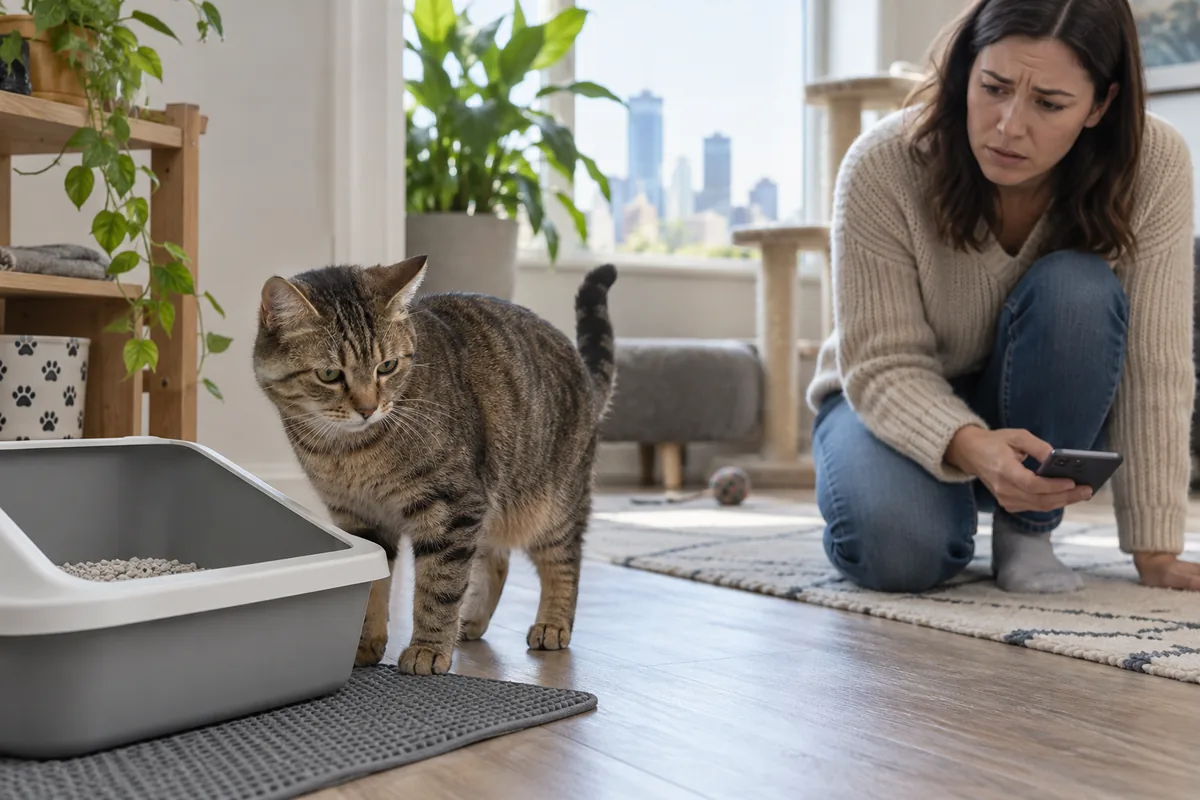
If your cat is straining in the litter box and producing no urine—or only a few drops—seek veterinary care immediately. A urinary blockage is especially common in male cats and can become life-threatening. Do not wait overnight to see whether your cat improves. If you cannot tell whether your cat is passing urine, treat it as urgent and call a veterinarian.
For Edmonton pet owners, the first decision is where to go. Lakeview Animal Hospital provides urgent assessment during clinic hours; call (587) 463-9002 so our team can direct you. If your cat appears unable to urinate, is very distressed, or needs care after hours, go directly to a 24-hour veterinary emergency hospital. Our Edmonton emergency-vet guide explains the difference between same-day and round-the-clock care.
What does a urinary problem look like in a cat?
A cat with lower urinary tract disease may visit the litter box more often, squat for a long time, cry out, lick around the genitals, pass small amounts of urine, urinate outside the box, or have blood in the urine. Some cats become quiet, hide, lose their appetite or vomit as they become unwell. These signs have several possible causes; they do not by themselves tell you whether the cat has a blockage.
- No urine or just drops despite repeated attempts: an emergency, especially for a male cat.
- Frequent, painful urination or blood in the urine: prompt veterinary assessment is needed, even if your cat is still passing some urine.
- Straining plus vomiting, weakness or collapse: go to an emergency hospital immediately.
Cornell’s Feline Health Center lists painful urination, frequent attempts, blood in urine and urinating outside the box as common signs. It emphasizes that a suspected urethral obstruction requires immediate treatment.
Could it be constipation instead?
Possibly, but it is difficult to distinguish straining to pass stool from straining to urinate by watching a cat in the box. Check for fresh, normal-sized urine clumps only if doing so does not delay your trip for care. A few drops or a damp spot do not prove that the bladder is emptying normally. If you are unsure, call a veterinarian right away rather than assuming constipation. VCA Animal Hospitals notes that owners may mistake painful urination for difficulty passing feces.
Why is a blocked cat an emergency?
The urethra is the tube that carries urine from the bladder out of the body. In a blocked cat, urine cannot leave normally. Waste products and electrolyte levels can change quickly, making the condition dangerous as well as painful. Male cats have a narrower, longer urethra and are at higher risk of obstruction. Female cats can also develop serious urinary problems and should be examined when they show symptoms. You cannot safely diagnose the cause or severity at home.
What should I do right now?
- Arrange veterinary care now. If no urine is coming out, choose an emergency hospital that can assess your cat immediately. During Lakeview’s hours, you may call us for direction; we may recommend going straight to a 24-hour facility.
- Transport your cat in a secure carrier. Note when you last saw a normal urine clump and whether there has been vomiting or a change in appetite. Bring medication and diet details if readily available.
- Do not press on the abdomen or try to empty the bladder. Do not give human pain medicine or leftover antibiotics. These steps can cause harm or delay appropriate treatment.
Lakeview is located at 4351 Savaryn Dr SW, Edmonton and is open Monday to Saturday, 8 a.m.–6 p.m., and Sunday, 10 a.m.–5 p.m.; statutory holidays are closed. We are not a 24-hour hospital. For a cat that cannot pass urine, getting to a facility equipped for emergency care takes priority over waiting for a regular appointment.
What may happen at the veterinary hospital?
A veterinarian will assess your cat’s overall condition and bladder. Depending on the findings, they may recommend urine testing, blood work and imaging to look for inflammation, stones, infection or another cause. If the urethra is blocked, treatment commonly involves relieving the obstruction with a catheter under sedation or anesthesia, stabilizing the cat and monitoring during hospitalization. The exact plan depends on the cat’s condition and the treating hospital’s assessment; Cornell describes the diagnostic and treatment approaches in detail.
What about aftercare and prevention?
After the immediate problem is treated, follow the veterinarian’s discharge plan closely. A cat with bladder inflammation may need a different plan from one with stones or an infection. Ask when your cat should produce a normal urine clump and exactly which signs mean you should return. A recurrence of straining with little or no urine is an emergency again.
Longer-term steps may include fresh water, clean and accessible litter boxes, weight management and a calmer environment. Some cats need a prescription diet or other treatment based on test results. Do not start a urinary diet or supplements without discussing your cat’s diagnosis with your veterinarian; there is no single plan for every urinary problem.
Common questions
My cat passed a few drops. Can I wait until morning?
No. Drops after repeated straining may occur with a partial or complete obstruction. Seek urgent veterinary advice now, particularly if your cat is male, painful or unwell.
Is blood in the urine always a blockage?
No. Blood can occur with several urinary conditions. Your cat still needs veterinary assessment, and the urgency rises if they are producing little or no urine.
Will antibiotics fix it?
Only if a veterinarian diagnoses a bacterial infection and prescribes them. Many feline urinary problems are not bacterial, and antibiotics cannot relieve a physical blockage.
Need help deciding where to go in Edmonton? During clinic hours, call Lakeview Animal Hospital at (587) 463-9002. If your cat cannot urinate or is becoming distressed, seek a 24-hour emergency hospital immediately. You can also read our urgent-care information before your visit.